Prof. Dr. Thomas Stiehl (RWTH Aachen)
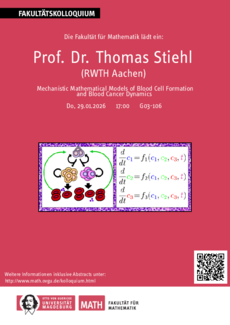
Every day, the human body produces over 100 billion blood cells. This tightly regulated process is driven by blood-forming (hematopoietic) stem cells, which give rise to a hierarchy of specialized cell types, ultimately producing red blood cells, white blood cells, and platelets. A complex network of regulatory loops ensures that blood cell production adapts to the body's current needs while preventing uncontrolled cell growth, as seen in blood cancers.
Given that both the shortage and overproduction of blood cells can lead to life-threatening complications such as bleeding, immune deficiencies, and thrombosis, a quantitative understanding of blood cell production is of high clinical need. This becomes especially important in the context of blood cancers, which rank among the most aggressive and difficult-to-treat malignancies.
This presentation will introduce a series of non-linear ordinary differential equation models designed to elucidate the dynamics of blood cell production under normal conditions, during regeneration, and in the case of blood cancers. The models are motivated by clinical or biological questions and account for key processes such as stem cell division and cell maturation.
By combining model analysis, computer simulations, and clinical data, we aim to address the following questions:
• What regulatory mechanisms ensure efficient blood cell regeneration after injury, chemotherapy, or bone marrow transplantation?
• How do blood cancer cells out-compete healthy blood cell formation? What mechanisms provide malignant cells with a competitive advantage?
• Why do blood cancers frequently relapse after therapy? What drives the selection and evolution of malignant cell clones, and how do their properties evolve over time?
• How do novel anti-cancer drugs impact on cancer cell dynamics?
• How does the blood-forming system change with aging?
• How can computational models aid in prognostication and inform personalized medicine strategies?
29.01.2026, Raum: G03-106, Zeit: 17:00